How uneven is it?
Walk the lawn with a long, straight piece of timber. Gaps of a centimetre or two can often be top dressed; anything deeper usually needs the turf lifting.

Even out bumps, dips and slopes
Turf Norwich levels uneven lawns across Norwich and Norfolk, taking out the humps and hollows that scalp under the mower, hold puddles and make a garden awkward to use.
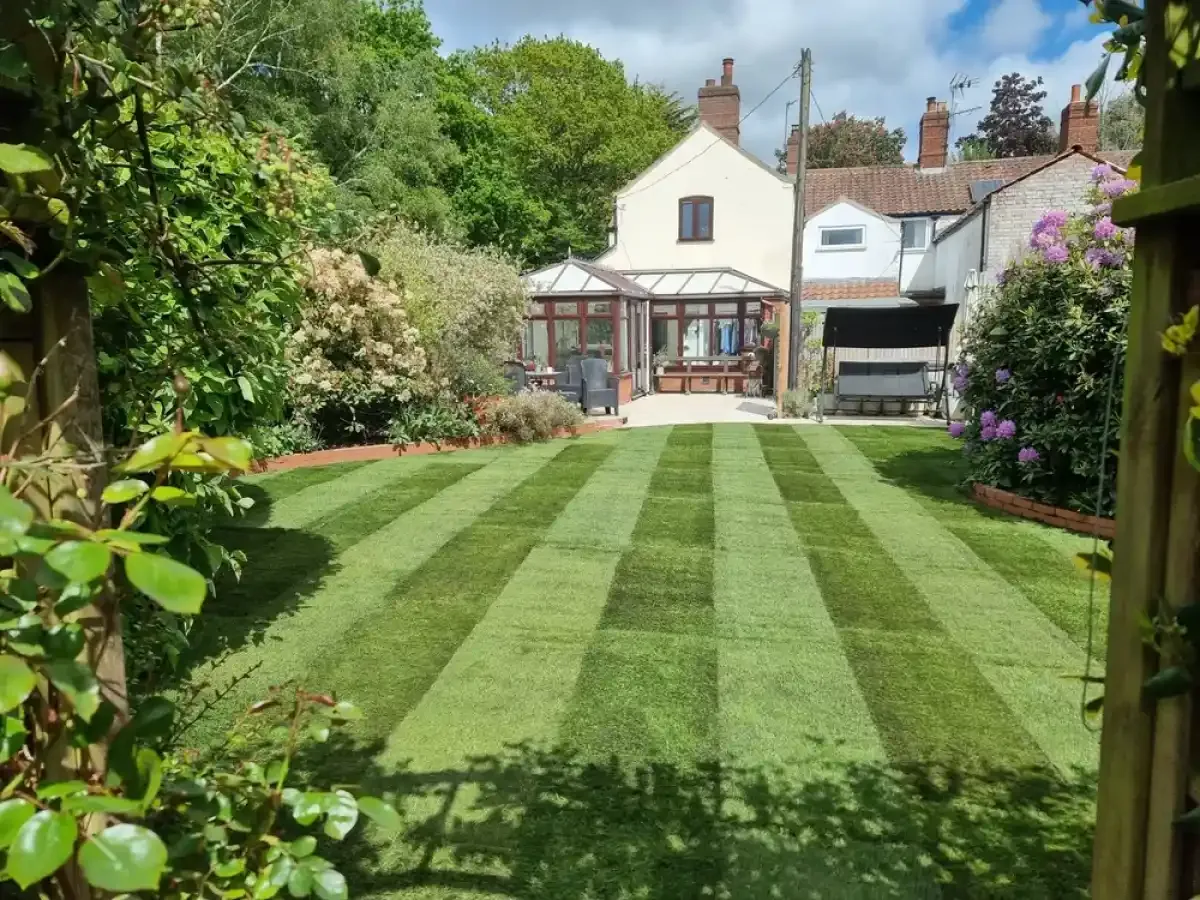
Lawns rarely start out bumpy. They become uneven over time as soil settles over old trenches and tree roots, as moles and ants push up mounds, as heavy feet wear hollows by the back door, and as clay shrinks and swells through dry summers and wet winters. The result is a lawn where the mower scalps the high spots and misses the low ones, and puddles sit for days after rain.
There are two ways to level a lawn. Small dips can be raised gradually by top dressing: spreading a fine soil mix over the grass so it grows up through it. Deeper problems and slopes need the turf lifted, the soil underneath regraded, and the lawn re-laid or replaced with fresh turf. We look at your lawn and recommend the one that will last, rather than the one that is easiest to sell.
The work depends on how uneven the lawn is, but usually involves some of these:
Walk the lawn with a long, straight piece of timber. Gaps of a centimetre or two can often be top dressed; anything deeper usually needs the turf lifting.
Think about old trenches, removed trees, a former pond or a soakaway. Knowing what is underneath helps us decide how to fix the ground for good.
A level lawn still needs a gentle fall away from the house. We plan levels so water drains away from walls and patios rather than towards them.
If the lawn is healthy, lifting and re-laying it keeps costs down. If it is mossy and thin, levelling is a good moment to replace it.
Raising a dip with top dressing works best in thin layers, so the grass is not smothered. Deeper dips may need more than one application.
Lifted and re-laid turf is treated like new: water it well and keep off it until it has rooted again.
Levelling evens out the ground, but if ants or moles are still active the mounds will return. Deal with the cause as well.
The grass grows strongly and recovers quickly in mild, moist weather, which is when levelling gives the best results.
We check the levels, the soil and the condition of the grass, and explain whether top dressing or regrading is the right fix.
Where needed, turf is lifted, high ground cut back and low ground filled and firmed.
The lawn goes back down, or fresh turf is laid, rolled and watered in.
Small dips are top dressed, and you get guidance on watering and mowing while it settles.
FAQs
Something else on your mind? Ask us when you request your quote, or call 01603 265243.
Often, yes. Shallow dips can be top dressed and the existing grass kept. Larger humps and hollows usually mean lifting the turf, regrading and re-laying it.
Gentle slopes can be regraded to make a lawn easier to use and mow. Steep slopes may need steps or retaining edges, which we will talk through when we visit.
Puddles usually sit in low spots or on compacted ground. Levelling removes the dips, and loosening the soil helps water drain through.
No, if done properly. Top dressing is applied thinly so grass grows through it, and lifted turf is re-laid quickly and kept watered.
Spring and early autumn, when the grass is growing well and the soil is moist but workable.
Yes. If the grass is poor, it makes sense to level the ground and lay fresh turf in one visit.
Out with the tired lawn, in with fresh turf on properly prepared ground.
New lawns laid on new builds, cleared plots and reshaped gardens.
Seed sown on a prepared bed for larger areas and patchy lawns.
A green lawn with no mowing, laid on a firm, free draining base.
Tell us about your garden and we will come and look, measure up and give you a free quote. No subcontracting: the team that quotes is the team that lays.