Access to the back garden
Turf, topsoil and the old lawn all have to come and go. Let us know about narrow side passages, steps or gates so we can plan how materials get through without damage.

Our main service
Turf Norwich replaces worn, weedy and uneven lawns across Norwich and Norfolk, lifting the old grass, preparing the soil properly and laying fresh turf in its place.
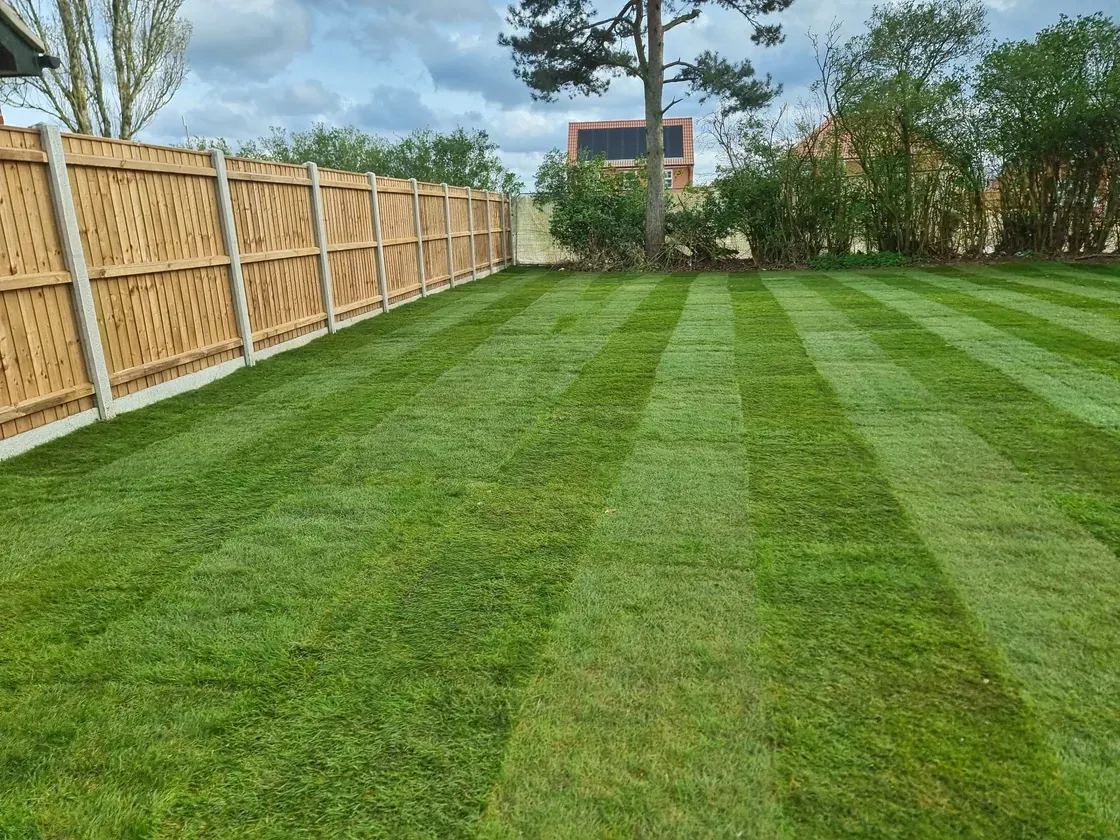
Some lawns can be rescued with feeding and scarifying. Others are too far gone: more moss and weed than grass, bare where the children play, sunk in places and lumpy in others. When that is the case, lawn replacement is usually quicker and more reliable than years of patching. We take the whole lawn back to soil and start again, so you get an even, healthy sward in one go.
Lawn replacement suits homeowners who want a lawn that looks right from the day it is laid: families who need somewhere to play, people getting a house ready to sell, and anyone tired of fighting the same patches every spring. It is the work we are asked for most, and the photos on this page show a typical result: bare, rotavated soil one morning and a striped new lawn soon after.
The difference between a replacement that lasts and one that struggles is almost always what happens before the turf arrives. That is why most of our time on a lawn replacement goes into the ground, not the grass.
Every job is quoted for the garden in front of us, but a typical lawn replacement covers:
Turf, topsoil and the old lawn all have to come and go. Let us know about narrow side passages, steps or gates so we can plan how materials get through without damage.
Lifted turf is heavy and bulky. Your quote will say whether it is being taken away or reused, for example stacked upside down to rot into soil in a corner of the garden.
New turf needs plenty of water for its first few weeks. Check you have an outside tap or a hose that reaches the far end of the garden.
Plan how to keep dogs and small feet off the new lawn while it roots. A temporary barrier or a different route to the shed for a few weeks makes a big difference.
Gaps opening between rolls in the first week usually mean the lawn needs more water. Water deeply in the evening rather than a little and often.
Some weeds will try to grow through in the first season from seeds already in the ground. Pulling them early, or a light first mow, keeps them in check.
Wait until the grass is around two to three inches tall and the roots have taken. The first cut should take only the top off, with the blades set high.
A crisp edge against borders and paths makes a new lawn look finished. Ask us about edging if you want a line that stays sharp.
We see the lawn, check the soil and levels, measure up and send you a free quote listing what is included.
The tired grass is stripped off and cleared, and the soil underneath is dug over and cleaned of stones and debris.
Topsoil goes in where needed, then the whole area is levelled, raked and firmed so it will not sink.
New turf is laid in staggered rows, cut neatly to the edges, rolled and watered in.
We talk you through aftercare and leave the garden tidy, with the new lawn ready to establish.
FAQs
Something else on your mind? Ask us when you request your quote, or call 01603 265243.
Yes. If only one area is worn or damaged we can replace that section, though matching new turf to an older lawn is never perfect for the first few months.
If more than about half the lawn is moss, weeds or bare soil, replacement is usually the better route. A lawn with good grass in most places can often be renovated instead.
We set the finished level to sit just below paths and patio edges so the mower runs over cleanly and water drains away from the house.
It can in mild spells, but not on frozen or waterlogged ground. We will suggest the best window when we quote.
Not necessarily. We need access to the garden, water and somewhere to leave materials. Many customers simply say hello at the start and look at the finished lawn at the end.
Water it deeply every day in dry weather for the first couple of weeks, keep off it as much as you can, and hold off mowing until it has rooted. We give you all of this in writing.
New lawns laid on new builds, cleared plots and reshaped gardens.
Bumps, dips and slopes taken out so the lawn mows and drains evenly.
Seed sown on a prepared bed for larger areas and patchy lawns.
A green lawn with no mowing, laid on a firm, free draining base.
Tell us about your garden and we will come and look, measure up and give you a free quote. No subcontracting: the team that quotes is the team that lays.